

 CALL US NOW
 EMAIL US NOW

by Lipp Law LLC
criminal defense Las Vegas
A probation revocation hearing is different from a criminal trial in several ways. Simply put- a probation revocation hearing occurs when you are charged with violating the terms of your probation and are ordered to appear before a judge who will decide, by a preponderance of the evidence, whether you have violated the terms of your probation.
To get a better understanding of what happens during a probation revocation hearing, let’s break down each of those components.
Understanding Probation Revocation
Understanding what happens when someone breaks the probation rules is important because it shows what can happen if they don’t follow the court’s orders. If a person on probation doesn’t do what they’re supposed to, like going to meetings or staying away from drugs, it can start a probation violation process. These rules help them get back on track and stay out of trouble. But if they don’t follow them, they can get in more trouble with the law. That’s why it’s essential to follow all probation rules carefully to avoid going to jail or facing other consequences.
Violating Probation Terms
As you are probably aware, your probation is subject to conditions you must adhere to. These conditions often include:
- Follow all local, state, and federal laws.
- Do not use any controlled substances, except with medical prescription.
- Submit to testing for use of controlled substances.
- Submit to breathalyzer tests.
- Consent to searches of your premises, vehicle, and personal property.
- Do not change jobs or place of residence without informing your probation officer.
- Do not travel outside the state without permission from your probation officer.
- Do not possess any firearms.
- Obey any and all special conditions of your probation.
Hearing Before a Judge
Unlike a criminal trial, which involves a jury making findings of fact, a probation revocation hearing is before a judge. The judge will hear arguments from both sides and render a decision.
Burden of Proof
In a probation revocation hearing, the prosecutor does not need to prove to the judge that you violated the terms of your probation “beyond a reasonable doubt.” The prosecutor need only prove that you violated the terms of your probation “by a preponderance of the evidence.” This is a lower burden of proof, which means it’s an easier job for the prosecution than the burden they normally have during a criminal trial to prove each and every element of a crime beyond a reasonable doubt.
“By a preponderance of the evidence” basically means that one side is more likely true than not. Therefore, if the prosecution can persuade the judge that there is a 51% likelihood that you violated the terms of your probation, they will be successful.
Outcome of the Hearing
If the judge finds that you violated the terms of your probation, the judge may impose stricter limitations on your probation or revoke your probation, which might result in imprisonment.
If the judge finds that you did not violate the terms of your probation, the current length and terms of your probation will continue.
As mentioned, the prosecution has a lower burden of proof in a probation revocation hearing than in a criminal trial, therefore, being represented by an experienced criminal defense attorney during a probation revocation hearing is crucial to protect your rights and freedom.
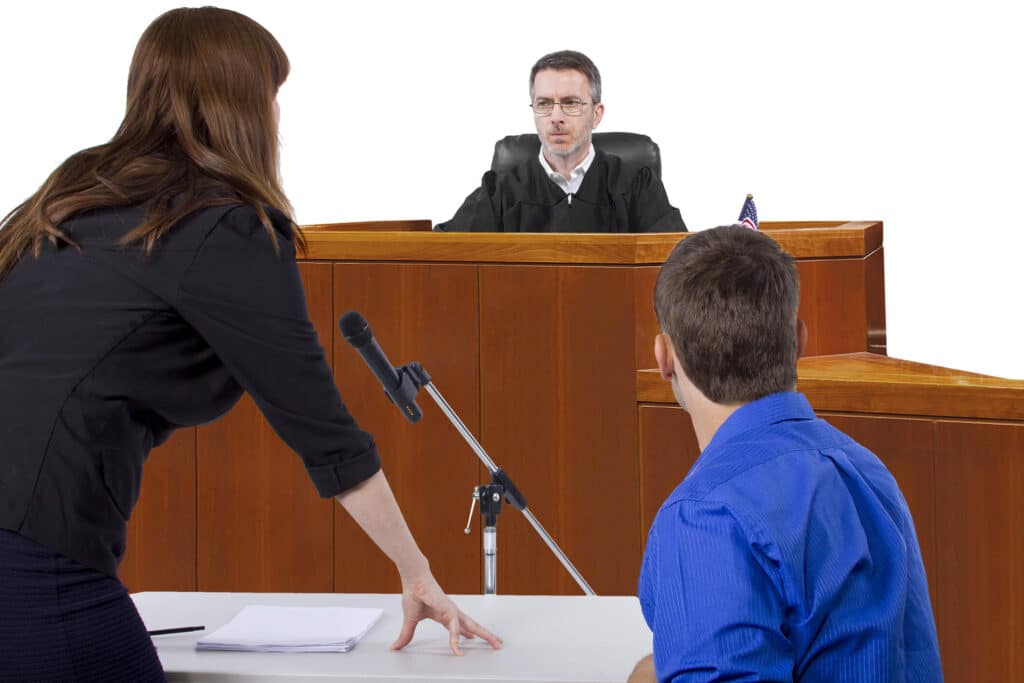
Probation Revocation Hearing Process
The probation revocation hearing process involves several key steps that determine the outcome for individuals accused of violating their probation terms:
1. Issuance of a Warrant or Summons
When a probation officer or prosecutor suspects a probation violation, they can ask a judge to issue either a warrant for the person’s arrest or a summons requiring them to appear in court for a probation revocation hearing. This step initiates the legal process and notifies the individual of the allegations against them, ensuring their presence in court to address the accusations and defend their rights.
2. Notification to the Defendant
Notifying the defendant is critical in the probation revocation process, ensuring they know the allegations against them and the upcoming revocation hearing. This notification includes details such as the date, time, and location of the probation violation hearing, allowing the defendant to prepare their defense. Importantly, defendants have the right to legal representation during this process, enabling them to seek guidance from an attorney to navigate the complexities of the legal proceedings and advocate for their rights effectively. This notification ensures fairness and transparency in the legal process, allowing defendants to participate fully in their defense.
3. Presentation of Evidence
During the probation revocation hearing, the prosecutor plays a crucial role in presenting evidence that backs the claim of a probation violation. This evidence encompasses various forms, including witness testimony, official documents like police reports or drug test results, and any other pertinent information. Witness testimonies provide firsthand accounts of the alleged violation, while official documents serve as concrete evidence to support the prosecution’s case. This comprehensive presentation of evidence aims to substantiate the allegations and provide the judge with a clear understanding of the circumstances surrounding the probation violation.
4. Defense Response
During the defense response phase of the probation revocation hearing, the defendant or their attorney is given the chance to counter the accusations brought forward by the prosecution. This involves presenting evidence or arguments that challenge the validity of the prosecution’s evidence. Additionally, they can offer mitigating circumstances to provide context for the alleged violation, aiming to reduce its severity or explain the reasons behind the actions in question. This crucial step allows the defendants to advocate for themselves and strive for a fair outcome.
5. Decision by the Judge
Once all evidence and arguments have been heard, the judge must make a crucial decision regarding the alleged probation violation. If the judge concludes that the defendant has indeed violated their probation terms, they proceed to determine the suitable consequences. These consequences may vary widely, from extending the probation duration to adding further conditions or revoking probation entirely. The judge’s decision hinges on the case’s specifics and aims to maintain accountability while promoting rehabilitation within the criminal justice system.
6. Sentencing Phase (if applicable)
During the sentencing phase, if probation is revoked, the judge determines the appropriate penalties for the defendant. This decision hinges on the seriousness and type of violation committed. Possible consequences include incarceration, monetary fines, or other sanctions outlined by legal statutes. The severity of the violation plays a crucial role in shaping the outcome of this phase, reflecting the judge’s discretion within the bounds of the law.
Importance of Probation Revocation Hearings
Probation revocation hearings hold significant importance within the criminal justice system for various reasons:
1. Ensuring Due Process – These hearings uphold the fundamental principle of due process by providing individuals on probation with the opportunity for a fair and impartial hearing before any additional penalties are imposed. This ensures that their rights are protected and that decisions regarding their probation status are made in accordance with the law.
2. Facilitating Individualized Justice – Judges presiding over probation revocation hearings have the discretion to consider each case’s unique circumstances. This allows them to consider factors such as the individual’s background, compliance with probation terms, and any mitigating circumstances that may have contributed to the alleged violation. As a result, decisions regarding probation revocation and sentencing can be tailored to fit the specific needs and circumstances of the individual involved.
3. Promoting Compliance with Probation Terms – The prospect of facing consequences for probation violations is a powerful incentive for individuals to adhere to the terms of their supervision. By making it clear that non-compliance can result in revocation of probation and potentially harsher penalties, these hearings encourage individuals on probation to take their obligations seriously and comply with the court’s conditions.
Probation revocation hearings are critical. They help keep the probation system fair and ensure everyone follows Nevada rules of criminal procedure. These hearings give people on probation a chance to explain their side of the story and show evidence. They help ensure that decisions about probation are fair and follow the law. Plus, they help people on probation stay accountable for their actions. By giving everyone a fair chance to speak and be heard, these hearings help make sure probation helps people get back on track and become part of society again after being in trouble with the law.
Conclusion
Probation revocation hearings are crucial for keeping the probation system fair and ensuring people follow the rules. They allow evidence and arguments to be heard fairly, following the law. These hearings help to make sure everyone’s rights are respected and that public safety is taken seriously. Knowing how probation revocation works helps us see how the legal system works and why it’s essential to stick to the rules of probation to avoid more trouble with the law.
FAQs
Here are some frequently asked questions about what happens during a probation revocation hearing:
Q. What evidence is considered during a probation revocation hearing?
During a probation revocation hearing, various types of evidence are considered. This evidence typically includes witness testimony, such as statements from probation officers or other witnesses to the alleged violation. Police reports, drug test results, and any other relevant records may be presented as evidence. The judge evaluates this evidence to determine whether the probationer has violated the terms of their probation and what consequences, if any, are appropriate.
Q. What rights does the defendant have during a probation revocation hearing?
During a probation revocation hearing, the defendant has several rights. These include the right to be informed of the alleged violation, the right to legal representation, the right to present evidence and arguments in their defense, and the right to a fair and impartial decision by the judge. These rights ensure that the defendant can contest the allegations and receive due process throughout the proceedings.
Schedule an Appointment With Lipp Law LLC Today!
At Lipp Law LLC, our team specializes in guiding clients through the intricacies of probation revocation hearings. If you’re seeking clarity on the process or require representation, our experienced criminal justice attorneys in Las Vegas, Nevada, are here to assist you.
With our expertise and dedication, we can provide invaluable insights and support to navigate the challenges of probation revocation proceedings. Whether you need assistance in understanding your rights, preparing for your sentence review, navigating the procedure of the hearing, or exploring options for appeal, we are committed to safeguarding your interests and achieving a favorable outcome.
Contact us today to schedule a consultation and take the first step towards protecting your rights and securing justice!
Under Nevada state law, Revised Statute 200.368, statutory sexual seduction and statutory rape are synonymous. Nevada makes it a crime for there to be any kind of sexual penetration between someone who is over the age of 18 and someone who is under the age of 16. The caveat is that in order for someone to be guilty of statutory sexual seduction in Nevada, the individual over 18 years of age needs to be at least 4 years older than the minor involved. This becomes critical when dealing with cases that involve a high school senior or college freshman who is dating a high school freshman or sophomore. In many situations, the statute doesn’t account for the possibility of these interactions being school romances.
It is important to know that it does not matter who the aggressor is or who initiates the sexual contact. For example, if a 15-year-old girl comes on very strongly to a 20-year-old man and he succumbs to the temptation, he is still criminally liable for his actions, regardless of the fact that the underage female was the one who initiated contact.
Can The Romeo and Juliet Defense Be Used In Nevada?
Nevada does not have a Romeo and Juliet law per se. In essence, this law provides a person who has been charged with statutory sexual seduction in Nevada or statutory rape with a defense that they’re in a relationship with the minor and close in age (i.e. within the four-year age range) to the minor, and therefore should not be charged with a crime.
While Nevada law does not provide for this defense, it does have an exemption built straight into the law, which essentially says that sexual intercourse between an 18-year-old and a 15-year-old is not considered statutory rape because there is not an age difference of at least four years. Unless the parents of the younger party felt that the consent was brought about by some ill means, most prosecutors would not consider the case to be one of statutory rape.
Who Can Be Prosecuted For Statutory Rape Under Nevada State Law?
Anyone who is 18 years of age or older and has penetrative sexual contact with someone who is under the age of consent is theoretically prosecutable for statutory rape. Most often, these cases involve a 14 or 15-year-old with someone who is 19, 20, 21, 22, or 25 years old. There’s a distinction to be drawn here between statutory rape and child sexual assault; statutory rape is generally going to be applied to adults in their twenties who are having sex with 14 and 15-year-old minors.
What Is Considered Lewdness With A Minor Under The Age Of 16?
Lewdness with a minor generally involves non-penetrative sexual contact (i.e. any kind of touching or physical contact that is designed to arouse the sexual passions of either the child or the adult doing the touching). This means that the touching doesn’t have to be on what we would call a private part of the body or a sexual part of the body, and certainly doesn’t need to be a touching of the genitalia; heavy petting could rise to the level of lewdness with a minor.
It is a serious offense that carries some serious consequences, but the consequences associated with child sexual assault (i.e. statutory sexual seduction with a child under the age of 14) are more severe. Some would say that lewdness with a child is the lesser-included of a child sexual assault case. If a case of child sexual assault cannot be made given a certain set of facts, there may at least be a case of lewdness with a minor. Nevada Revised Statute 201.230 makes it illegal for an adult who is over the age of majority to touch a child under the age of 16 with the end goal of arousing the child’s or the adult’s sexual gratification.
For more information on Statutory Rape Under Nevada State Law, a free legal consultation is your next best step. Get the information and legal answers you are seeking by calling 702-745-4700 today.
2580 Sorrel St, Las Vegas, NV 89146
(702) 745-4700
In the wake of the pandemic, many people have decided to travel in a personal vehicle instead of traveling by air. Therefore, situations arise that would not otherwise be thought about prior to this crisis. Traveling across the country gives rise to some unusual situations. This a good subject regarding the laws of drinking in vehicles that are parked overnight.
Scenario Situation: Car Camping and Drinking
I recently started to travel all over the country. I make enough money working online to live comfortably out of my full-size Suburban. My new passion for drones has me moving from place to place for that perfect footage making camping in my vehicle the perfect solution. I have a couple of questions about whether or not I will be able to have a beer or two while camping in my car. If I am in a rest stop or permitted parking In the evening and have a couple of drinks in the back of my vehicle before I go to sleep, can I get arrested for DUI? Or better yet, how could I prevent getting one? I know you’re going to say don’t do it, but at this time it’s easier to stay in my vehicle than to pay for a hotel every night. Sometimes I’m not even near a hotel. I don’t need much more than what I have right now and with this whole covid 19 thing it just makes it easy to travel without having to interact with too many people or come in contact with a lot of different places.
As a side note for drone pilots, I never fly my drones when I have been drinking as it’s against FAA regulations and it could harm someone.
Tips To Avoid a DUI While Car Camping
First, we have to say it…do not do it at all.
Second, if you are going to do it the following tips could help you avoid a DUI depending on the particular state you are currently traveling in.
- Do not put the keys in the ignition. In a lot of states including Nevada keys in the ignition is 1 indicia which may be considered regarding the intent of driving. Without the keys in the ignition, it could be hard to prove intent and driving itself.
- If possible lock the keys in a lockbox.
- Doing your best to be in the back of the vehicle is advised. And keep the keys out of the ignition. This could show you do not intend on moving the vehicle.
- You have to make every intention to try to be clear that you would not be driving, but most important of all, just do not do it.
Am I at risk of sleeping in my car after drinking?
Once you have been drinking you are always at risk. Think about whether it would be smart to do so. For example, where are you? Is it cold outside? Will you have enough heat without the engine running? You have to be sober before you can move that vehicle. Consider the same thing in the heat depending on where you are at. Once the keys touch the ignition, every intention is there. In Nevada, we have represented many clients who had the car running because of the heat and fell asleep. There are many factors: Where was the driver (passenger seat is good or back seat is best) Again, just don’t do it.
When I am camping in my car can I get into trouble for an open container in a trash bag inside the vehicle?
If it’s in a trash bag it’s trash. However, it would be a good idea to put the bag outside the vehicle or in a place that is inaccessible until you’re ready to drive then get rid of it as soon as possible.
Do not litter, always pick up your trash and dispose of it properly. Best advice, just do not do it.
Can I be convicted of DUI for sleeping in my car in Nevada?
Yes, if the following two conditions are true:
- You are impaired by drugs or alcohol, or else your blood contains more than the legal limit of alcohol or drugs; AND
- You are “in actual physical control” of the motor vehicle. Even if you are not driving, you could be in actual physical control.
2) How can a sleeping person be “in control” of a parked motor vehicle in Nevada?
Whenever the keys are in the ignition. Under Nevada DUI law, having your keys in the ignition is a factor in determining whether you are in actual physical control of the car even if the engine is off and you are sleeping in the backseat or by the side of the road.
There are additional circumstances that make it more likely for police to arrest a sleeping person for DUI. These include:
- The car lights are on;
- The car is on a public road; or
- You are sleeping in the driver’s seat, always sleep in the passenger seat, or better yet the back seat.
In Rogers Vs State. The Nevada Supreme court delineated actual physical control but there is no bright-line rule.
The court concluded that a person is in actual physical control when the person has existing or present bodily restraint, directing influence, domination, or regulation of the vehicle. In deciding whether someone has existing or present bodily restraint, directing influence, domination, or regulation of a vehicle, the trier of fact must weigh a number of considerations,
1 including where, and in what position, the person is found in the vehicle;
2 whether the vehicle’s engine is running or not;
- whether the occupant is awake or asleep;
- whether, if the person is apprehended at night, the vehicle’s lights are on;
- the location of the vehicle’s keys; whether the person was trying to move the vehicle or moved the vehicle;
- whether the property on which the vehicle is located is public or private;
- and whether the person must, of necessity, have driven to the location where apprehended.[5]
- Another issue is when the driving occurred. If it cannot be determined that the chemical test ( breath or Blood) was taken within 2 hours of driving then the Blood alcohol content (BAC) would be inadmissible.
- This is why you need an experienced DUI lawyer
Although more costly would it be better for me to look for a KOA campground?
Yes, good question, usually KOA campgrounds are notorious for malfeasance (wrongdoing or unlawful conduct) and police monitoring them. If you were to stay at a KOA, we would suggest no partying, no loud music, and don’t bring attention to yourself. Another option would be to find a quieter campground that is more cost-effective for your situation. The website Outside How has a terrific article on 50+ Useful Camping Apps that could help you find something in a pinch.
Consult a Local DUI Defense Attorney
Drinking in your car is a very risky thing. We can provide advice about how to avoid a DUI while sleeping in your vehicle but every situation is unique. The bottom line will be the local laws along with the local law enforcement you come in contact with.
If your intent is to drink in a parked vehicle, we suggest you contact a local DUI defense attorney to review the current state laws. Your best defense will be to make every attempt to show you did not intend on driving. One final piece of advice is to just not do it.
If you or someone you know has been arrested for a DUI while camping in their car in Nevada give us a call. Schedule a consultation with DUI Defense Attorney Daniel Lippmann to review your case at (702) 745-4700.
For more information on how criminal lawyers can help you with Tips to Avoid a DUI While Camping in Your Vehicle, please contact us at (702) 745-4700.
2580 Sorrel St, Las Vegas, NV 89146
(702) 745-4700
 Lipp Law LLC
 (702) 745-4700
 info@LippLaw.vegas

